
Net zero ‘best issue’ for pensions engagement
Trustees at Net Zero Investor’s Defined Contribution Forum make the argument that climate concerns are the best way to engage all members of DC pensions.
When it comes to defined contribution pensions, issues concerning net-zero investments are “the best and only issue which will engage everybody”, according to Raymonde Nathan, a professional independent trustee at PAN Trustees.
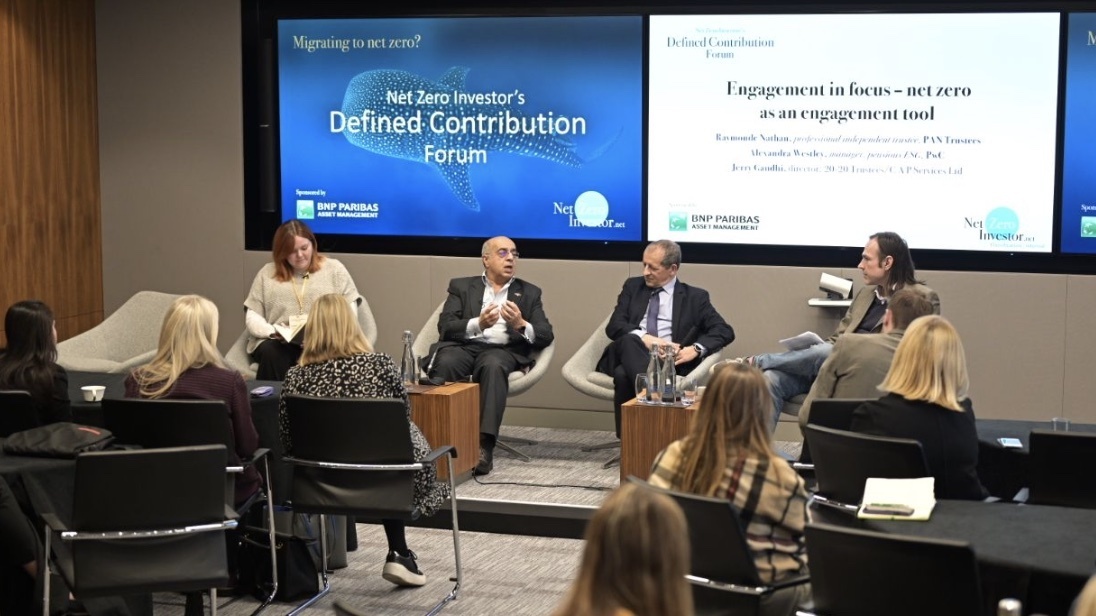
The comments were made at Net Zero Investor’s inaugural Defined Contribution Forum, at a panel discussion on the topic of “net zero as an engagement tool.” Also speaking on the panel were Alexandra Westley, manager on the pensions ESG team at PwC, and Jerry Gandhi, a director at 20-20 Trustees.
“Part of a trustee’s fiduciary duty is to make sure we've actually got a world in the future to invest in. How could it be right to invest in something that's going to destroy the planet in the next 50 years?”, said Nathan.
Gandhi also stressed that net-zero considerations were especially relevant for younger generations enrolled in DC pension schemes, and that the development of social media campaigns with climate considerations at the forefront could be an effective engagement tool.
Nathan also warned of “unintended consequences” of effective engagement, arguing that overly effective engagement on an issue such as decarbonisation could lead to members only taking interest in the scheme on a one-time basis, rather than being involved in an ongoing “engagement journey”.
Part of a trustee’s fiduciary duty is to make sure we've actually got a world in the future to invest in.
DC pensions in a carbon-intensive world
A further panel at the event covered the topic of credible net-zero action plans in the DC sector. This featured Cleo Fitzsimons, head of responsible investment at the Pensions Insurance Corporation, James Monk, an independent adviser, Faisal Sattar, investment analyst at Evolve Pensions, and Jonathan Lawlor, senior consultant for investment at XPS Pensions Group.
When asked on the effectiveness of DC pensions shifting to net zero if carbon emissions were still at high intensity in the wider financial sector, Fitzsimons pointed to regulatory developments: “Net zero by 2050 has a huge impact on energy and mining companies. Yet we still need energy, we still need all commodities. So you can't penalise the sector for the fact that their sector is more carbon-intensive in general.
“However, regulations for disclosure and reporting are absolutely fantastic. They really do help us understand what's going on and help us with making sure that we're on the right trajectory. The work on the TNFD [Taskforce on Nature-related Financial Disclosures] is bringing new dynamics and you can extend out that principle to new areas.”
Fitzsimon’s remarks were echoed by Monk, who argued that different industries and sectors will have different pathways and different targets that they can realistically achieve.
Biodiversity pledge
At a panel discussion on incorporating biodiversity concerns into DC investing, Will Martindale, head of sustainability at NOW: Pensions, spoke of recent developments at the COP15 conference on biodiversity in Montreal, including a pledge to protect 30% of the Earth’s land and sea by 2030.
“[This pledge] replaces a previous agreement from 2010, which had a bunch of indicators, and every single one of those indicators was not met. This comes back to domestic law and domestic legislation. Unless governments translate this new pledge back into their own management of land, then it unfortunately doesn't have any value,” said Martindale.
Gemma James, head of biodiversity and nature at Chronos Sustainability, also observed that the next biodiversity COP, to be held in Turkey in 2024, needed to develop a measurement system on top of the pre-existing framework, to be able to focus on how to measure success against targets.
The Defined Contribution Forum was hosted at the London Stock Exchange, and follows from Net Zero Investor’s first annual conference, hosted in December 2022.