
Green divide: Canada’s pension giants split on climate
As political headwinds and climate impacts worsen, Shift’s latest report card reveals which pension funds are taking action—and which ones are falling behind
While Canada's pension sector is building momentum on climate, a worrying gap is emerging between leaders and laggards, Canadian climate campaigners warn.
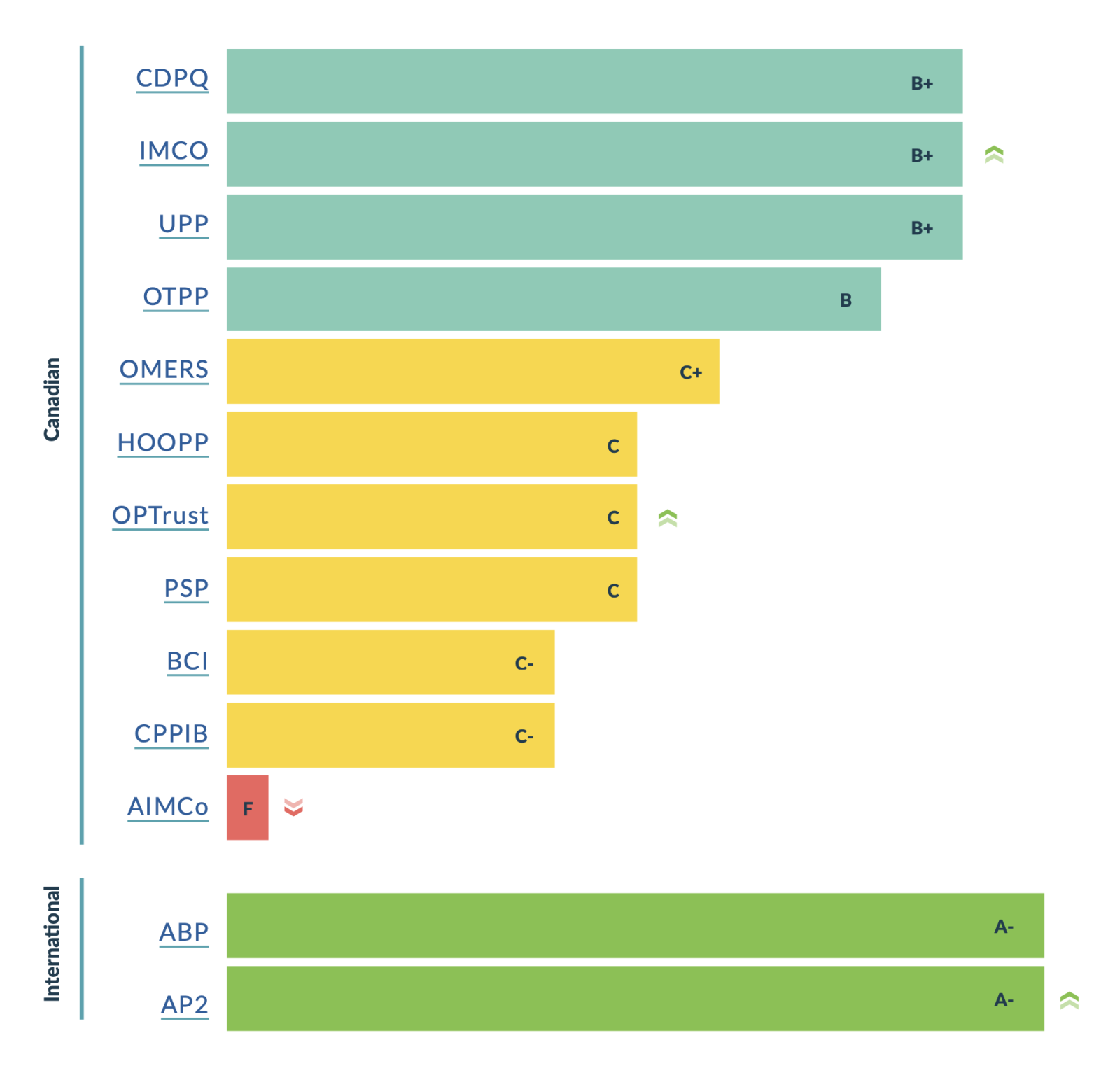
The latest annual climate report card produced by non-profit Shift: Action for Pension Wealth and Planet Health, tracks the climate policies of 11 of Canada’s largest pension managers. It puts Investment Management Corporation of Ontario (IMCO), Ontario’s University Pension Plan (UPP) and the Caisse de dépôt et placement du Québec (CDPQ) at the front of the pack, just in front of the Ontario Teachers’ Pension Plan (OTPP).
Funds in the middle of the pack, such as the Ontario Municipal Employees Retirement System (OMERS), Healthcare of Ontario Pension Plan (HOOPP) and OPSEU Pension Trust (OPTrust), have made “important incremental progress”, the analysts claim.
Others, such as the Public Sector Pension Investment Board (PSP) and the British Columbia Investment Management Corporation (BCI), have “lagged behind, undermined by their ongoing refusal to commit their portfolios to net-zero emissions”.
The Canada Pension Plan Investment Board (CPPIB) has seen its score drop in two categories in 2024 and is the only fund to see lower scores on any indicator two years in a row. Canada’s $675bn national pension manager continued to “undermine its climate credibility” through its “refusal to set interim emissions reduction targets, persistent greenwashing from its executives, its ongoing financing of high-risk fossil fuel expansion, and its fundamentally flawed decarbonisation thesis for fossil fuel companies”, according to Shift.
The Alberta Investment Management Corporation (AIMCo), already in last place in previous report cards, fell further behind due to “blatant political interference in its governance, seemingly driven by fossil fuel interests”. AIMCo becomes the first pension manager to receive an overall F in any of Shift’s report cards.
Momentum building
Despite poor scores for certain institutions, the Canadian pension sector as a whole has made significant progress in recent years, Shift claims.
By staffing up and building their climate expertise, Canadian pension managers have fed “a slow but steady sector-wide rollout of climate strategies” that include emissions reduction targets, commitments to green investment, and plans for helping portfolio companies decarbonise.
Pension fund teams have tackled emissions reporting and worked to close data gaps, analysed the effects on their portfolios of a range of possible climate scenarios, and implemented varying levels of climate due diligence in the investment process. Investment managers have started to study how the energy transition will play out in order to understand areas of growth and opportunity.
Then, behind the scenes, many funds appear to be recognising that coal, oil and gas have lost their investment thesis: some funds have announced partial exclusions on new fossil fuel investments while other funds seem to have in place unspoken but de facto exclusions.
Some pension funds have begun to coordinate on climate policy engagement, for example on climate disclosure standards and calling for the federal government to move forward a long-awaited taxonomy for what counts as a “green” or “transition” investment.
In 2021, several Canadian pension managers joined with other institutional investors to launch Climate Engagement Canada, an attempt at engaging with the country’s highest emitting public companies on achieving the Paris Agreement’s 1.5C goal.
“After a late start that saw them lag behind their international peers, especially those in Europe, many of Canada’s pension funds have quickly built momentum on climate alignment,” the report states. “A few Canadian pension managers have gone further, seeking to establish themselves as leaders on the road to a livable future.”
These early leaders have taken voluntary action on disclosure and accountability that “sets an example for other institutions and creates space for authorities to introduce regulations requiring credible climate alignment across the financial sector”.
Such actions mark a sharp contrast to “only a few years ago” when the Canadian pension sector “had not yet acknowledged the scale of the climate crisis and the degree to which mounting climate risks threatened pension funds’ ability to fulfill their long-term obligations”.
Worrying global context
The authors note that the third edition of Shift’s report card comes during a “dangerous moment” for the pension sector and the world, characterised by worsening climate impacts and an increase in reactionary governments that threaten to roll back progress on emissions reductions.
US president Donald Trump is driving ahead on promises to block or undo major planks of the Biden administration’s climate policy, including rescinding “all unspent funds” allocated under the Inflation Reduction Act, scrapping offshore wind projects, rolling back electric vehicle mandates and emissions regulations, and imposing tariffs on battery materials.
Meanwhile, in Canada, a new federal government in 2025 could “look to dismantle the existing carbon pricing system, remove the emissions cap and further expand oil and gas production”, Shift warns. The government of Alberta has already imposed harsh restrictions on solar and wind projects that do not apply to the oil and gas sector, throttling what was the fastest-growing renewable.
“The climate crisis is subject to the laws of physics and not to four-year election cycles,” said Adam Scott, executive director of Shift. “Far from an excuse for slowing climate action, political backsliding only increases the urgent need for financial leadership to fill the void. Pension funds require a stable climate to fulfill their mandates and obligations.”
The global average temperature for 2024 was approximately 1.55C above pre-industrial levels, making 2024 the first calendar year to exceed the 1.5C goal set in the Paris Agreement. Long-term warming, measured over decades, has not yet crossed the 1.5C threshold.
The United Nations Environment Programme’s October 2024 emissions update warned that current mitigation policies would likely only limit the increase in global warming to 3.1C over the course of the century, and would leave “virtually no chance” of limiting warming to 1.5C.
The Insurance Bureau of Canada called 2024 “the most challenging year on record for damage from severe weather events and natural disasters,” announcing in November that insured losses in Canada alone—a tiny fraction of overall economic losses from climate impacts— had already set a new annual record of $7.7bn.